
Hospitals & Healthcare — Condensation Control
Hospital Condensation Control & Thermal Insulation Ireland
Spray-applied natural cork thermal treatment for hospital plant rooms, service corridors, external walls and older healthcare buildings. By raising surface temperature and managing dew point, an appropriate VIPEQ thermal coating helps prevent condensation in medical facilities.
Condensation & Thermal Bridging in Hospitals
Hospitals and healthcare facilities must maintain strict hygiene and environmental standards. Condensation on cold surfaces — plant room walls, service corridors, external walls, concrete structures and roof structures — introduces moisture that can promote mould growth and compromise infection control standards.
Older hospital buildings with solid walls and exposed concrete structures are particularly vulnerable to thermal bridging, where columns, beams and junctions create localised cold spots that condense moisture even in otherwise heated wards and departments.
A spray-applied natural cork thermal coating applied directly to the cold substrate raises its internal surface temperature, reducing the conditions that lead to condensation — without the space loss and disruption of rigid insulation in occupied healthcare environments.
Important — Technical Suitability
Any VIPEQ system proposed for a healthcare environment must be confirmed as technically suitable for the specific area, substrate and hygiene context. Contact us with details of your facility and we can advise on suitability.
Surface Temperature, Dew Point & Condensation
Condensation forms when warm, moisture-laden air meets a surface whose temperature has fallen below the dew point. By improving the thermal behaviour of a cold surface, an appropriate thermal coating can help raise the internal surface temperature and reduce the conditions that lead to surface condensation.
Humidity
Surface Temp
Dew Point
Key Benefits
Where Thermal Treatment Applies
Plant Rooms
Anti-condensation treatment for walls and steelwork in hospital boiler, chiller and mechanical plant rooms.
Service Corridors
Thermal bridge treatment along concrete columns, walls and junctions in service and circulation routes.
External Walls
Surface temperature management on cold external wall surfaces in wards and department areas.
Concrete Structures
Thermal bridge treatment at concrete columns, beams and soffits that create localised cold spots.
Older Hospital Buildings
Vapour-permeable thermal treatment for solid-wall and traditional hospital buildings where moisture must not be trapped.
Roof Structures
Anti-condensation treatment for roof surfaces above sensitive department areas.
A Natural Cork Thermal Coating — Not a Paint
VIPEQ's cork-enhanced thermal coating systems are spray- or trowel-applied directly to the substrate, forming a thin, flexible, vapour-permeable thermal layer that conforms to irregular surfaces — steel, concrete, masonry and timber — without rigid boards, battens or significant loss of internal space.
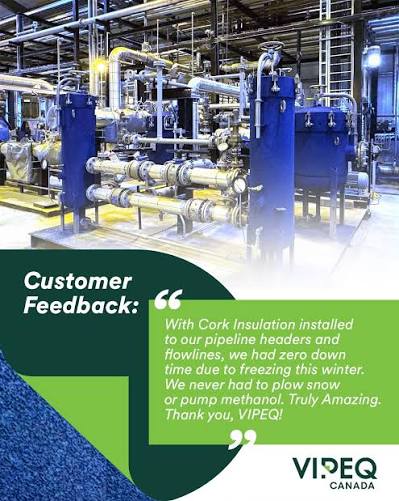
Customer Feedback:
With Cork Insulation installed to our pipeline headers and flowlines, we had zero down time due to freezing this winter. We never had to plow snow or pump methanol. Truly Amazing. Thank you, VIPEQ!
VIPEQ
Ireland
Frequently Asked Questions
Related Solutions
Not sure which system applies?
Send us photographs, drawings or details of the substrate and application and we can assess whether a VIPEQ system is suitable — free, no obligation.
Have a Condensation, Cold-Surface or Thermal-Bridging Problem?
Send us photographs, drawings or details of the substrate and application and we can assess whether a VIPEQ system is suitable for your project.