
ICF Render Systems — Ireland
A Better Finish for
ICF Buildings in Ireland
Standard acrylic and silicone renders crack, stain and fail on ICF facades. VIPEQ flexible cork coating moves with the building, sheds Irish rain, and stays looking right — long term.
Why Acrylic and Silicone Renders Fail on ICF Facades in Ireland
Render Cracking
Standard acrylic and silicone renders on ICF are rigid. As EPS foam expands and contracts with temperature, the render cracks — letting water in behind the finish.
Algae & Staining
The smooth, sealed surface of many ICF renders traps surface moisture. In Ireland's damp climate this quickly leads to green algae growth, staining and a deteriorating appearance.
Board Pattern Visibility
Where renders are applied too thinly or lose adhesion at joints, the underlying ICF block pattern telegraphs through the finish — particularly visible in raking light.
Wind-Driven Rain Exposure
Ireland's Atlantic weather means ICF façades face sustained wind-driven rain. Rigid finishes with micro-cracks become pathways for water ingress, damaging insulation performance.
A Flexible Cork Coating That Moves With Your ICF Building
ICF construction is excellent — thermally efficient, airtight and structurally strong. The weak point has always been the external finish. EPS foam moves with temperature, and rigid renders can't keep up. VIPEQ Thermal Corkspray is naturally elastic — it accommodates this movement without cracking.
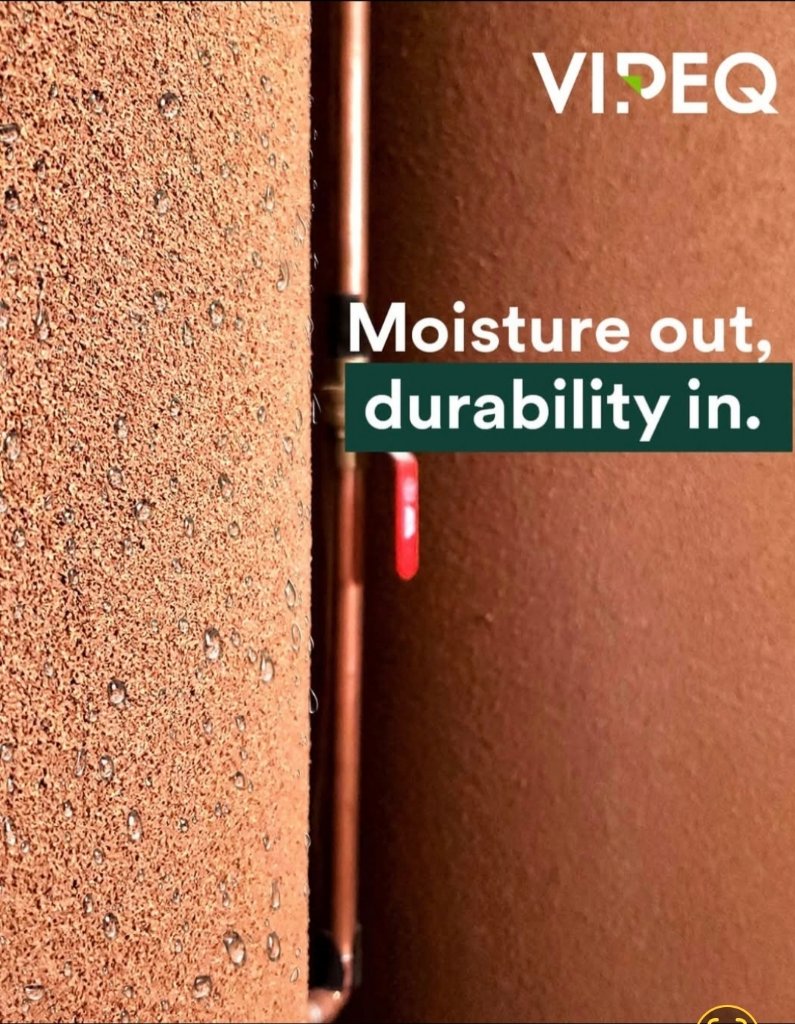
Because cork is vapour-permeable, any moisture that enters the wall assembly can still escape — preventing the trapped moisture problems that damage insulation performance and lead to mould.
Why Choose Cork Coating Over Standard ICF Render?
Flexible — won't crack
Cork's natural elasticity accommodates ICF thermal movement without cracking or delaminating.
Vapour-permeable
Allows moisture to escape from the wall rather than being trapped behind a sealed surface.
Water-repellent surface
Sheds wind-driven rain while still breathing — essential for Ireland's exposed coastal and rural locations.
Bridges joints & boards
Spray-applied finish covers ICF block joints and minor surface irregularities for a consistent facade.
Algae-resistant texture
Natural cork surface drains faster and is less susceptible to algae colonisation than smooth sealed renders.
Natural & sustainable
Cork is harvested from living trees — renewable, biodegradable and low-carbon compared to synthetic acrylic systems.
Cork Coating vs Standard Acrylic/Silicone Render on ICF
| Property | VIPEQ Cork Coating | Standard Acrylic/Silicone |
|---|---|---|
| Flexibility | Highly elastic — moves with the building | Rigid — cracks under thermal movement |
| Vapour permeability | Vapour-open — breathable | Sealed — can trap moisture |
| Crack resistance | Bridges movement — self-accommodating | Prone to hairline cracking at joints |
| Algae resistance | Textured — drains quickly | Smooth sealed surface holds moisture |
| Board pattern risk | Spray covers joints uniformly | Thin application can reveal blocks |
| Material origin | Natural renewable cork | Synthetic petrochemical-based |
ICF Facades Need a Finish That Can Handle Irish Weather
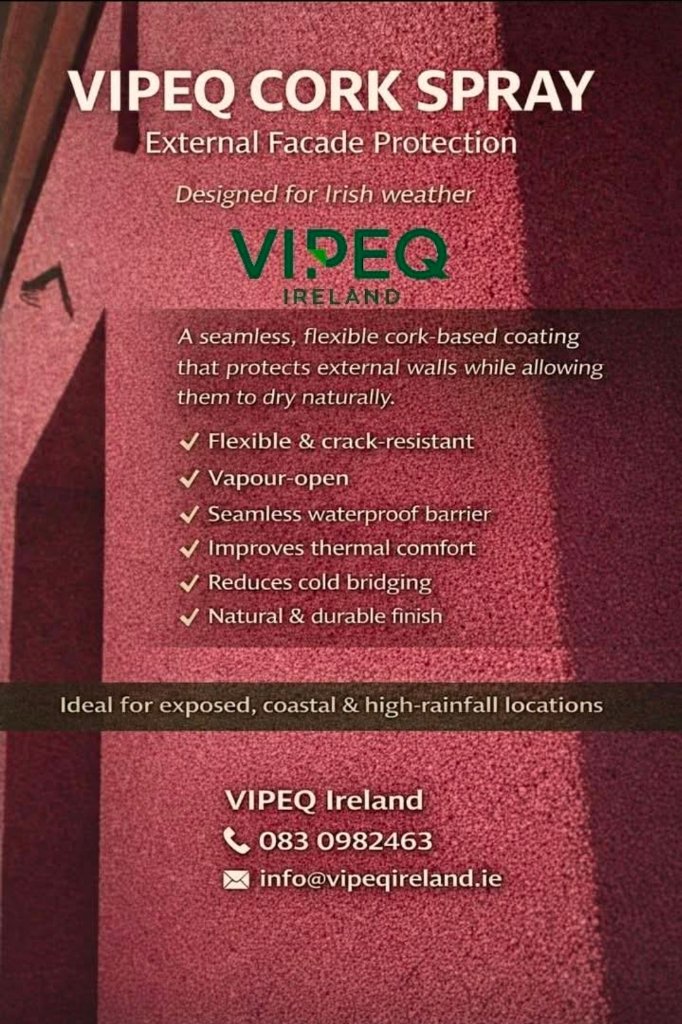
Ireland's Atlantic climate — sustained westerly winds, high annual rainfall and frequent temperature cycling — is demanding on any external finish. Standard ICF renders that perform adequately in continental conditions often show problems in Ireland within a few years.
Suitable For
What Our Customers Say
"Built our ICF house two years ago. The acrylic render started cracking along the block joints after the first winter — you could see the pattern showing through in certain light. VIPEQ cork sorted it completely. No cracks, looks much better."
Ronan Byrne
Self-Builder — Carlow
"We had algae creeping up the north-facing gable within a year of moving in. The ICF render just wasn't shedding water properly. VIPEQ cork coating has made a huge difference — the wall dries out quickly now and no sign of algae returning."
Fiona Doyle
Homeowner — Kildare
"I've started specifying VIPEQ cork on ICF projects instead of silicone render. The flexibility is the main reason — ICF moves more than masonry and you need a finish that can accommodate that. Very positive feedback from clients."
Darragh Connolly
Architect — Galway
Frequently Asked Questions
Building or Renovating an ICF Home in Ireland?
Send us photos or details of your ICF project and we'll advise on the most suitable VIPEQ finish — no obligation, free assessment.